
Rice360 Institute for Global Health Technologies caught up with program alumns to discuss their experiences beyond the hedges. Eniola Adeleke '25 shares insights from her experiences developing her Malaria diagnostic tool, Riascope.
We have a tradition in the University of Lagos, Nigeria (UNILAG) design studio. Every year, all staff, including student staff, are asked to complete a personal project. We identify a problem, develop a concept, and build a solution to address it. At the beginning of the year, we start by exploring needs across different sectors or fields. I looked and thought, "I want to do something in the healthcare sector." And I wanted to do something to address disease control.
I knew I did not have the skills in biology or parasitology, but I had skills in data science, embedded systems, control, and rapid prototyping. My questions were: “How can I apply the skills I already have to a major healthcare problem in Nigeria? Especially in disease control?” And that's how Riascope came about. I decided to examine one of the major diseases in Nigeria – malaria. I decided to focus on the diagnostic part of malaria because I knew that if you can detect malaria early, there's a very good chance that you can treat it early. Early diagnosis can help prevent high death rates from malaria and can save lives.
The reality in Nigeria is that the healthcare sector is severely understaffed. We're looking at a ratio of roughly one hematologist to every one million patients. Traditional malaria diagnoses require healthcare workers to take a blood sample and then examine it under a microscope. That's a lot of human labor and it is stressful and slow.
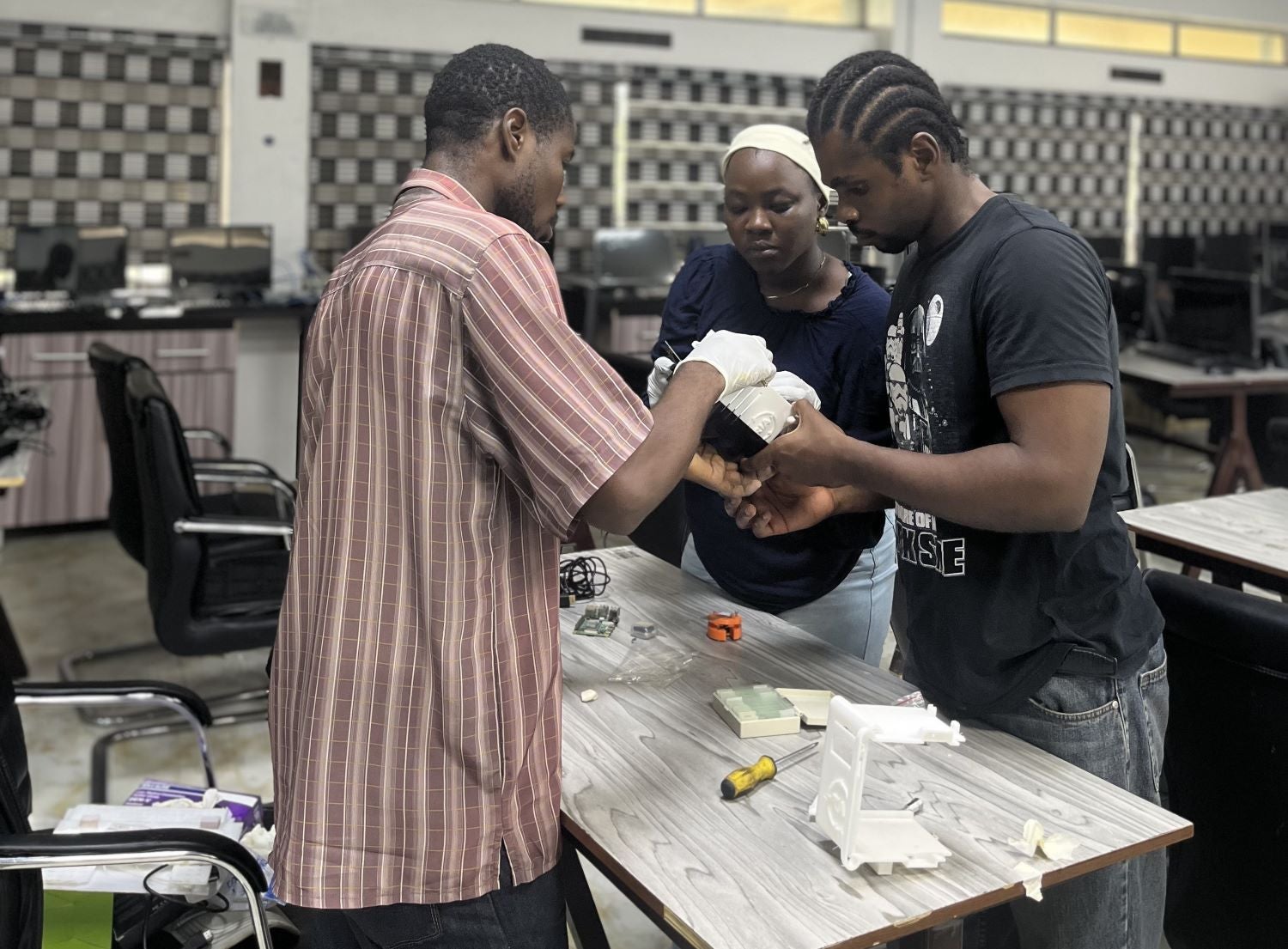
I created a specialized tool that automates this workflow. Riascope acts like a "mini microscope" that automates the entire process and can diagnose malaria in four minutes without human intervention. It automatically scans the blood sample using specialized microscopic lenses, then provides a sheet or data frame indicating the particular species of malaria present. From there, it's left to the doctor to confirm the diagnosis, and the entire screening process is automated.

Riascope is built on a high-performing recognition model trained on image datasets for these malaria parasite species. In Nigeria, we have different malaria species compared to other African regions. So we trained our system specifically on Plasmodium falciparum and Plasmodium ovale, the more common species here. My team and I have spent months iterating, tuning algorithms, expanding datasets, and ensuring our model recognizes the distinct shapes and forms of different Plasmodium species. Riascope detects multiple malaria species, and we continue improving our accuracy as we train on more datasets.
It has been an incredible journey of iteration. Since 2024, we've moved from initial prototypes to actively building our Minimum Viable Product (MVP) designed for field use. Honestly, building hardware of this nature is a very capital and resource-intensive undertaking, especially at this critical stage of moving from prototype to a field-ready product. However, we're making steady progress.
We've received significant support along the way. We've patented and registered Riascope Systems Limited as a startup in Nigeria in 2024. We secured prototype funding and a seed grant of 1.2 million Naira through the I2M (Innovation to Market) University Incubator program in the Innovation Technology Management Office at the University of Lagos. Currently, we're also proud to be one of just 20 innovators selected nationwide for the i-FAIR program (Innovation Fellowship for Aspiring Inventors and Researchers), organized by the Embassy of the State of Israel in Nigeria, which will support us in scaling our MVP. I'm thrilled and encouraged that the Nigerian community is taking this project seriously.
In medical technology, validation is everything, so accuracy is one of our top priorities. By 2026, we plan to formally begin clinical validation with the Lagos University Teaching Hospital (LUTH) and establish a partnership with the Nigerian Institute of Medical Research (NIMR). Working with NIMR will help us gather large, diverse datasets needed to make our AI model robust. We also recognize Rice360’s long-standing partnership with LUTH and hope to leverage that ecosystem for mentorship and smoother clinical navigation. Having the guidance of experienced partners like that would help us navigate these clinical pathways and accelerate our validation significantly.
I'm fortunate to work with a brilliant, multidisciplinary team. While I lead the hardware design and business development, I work with Emelife Tobechukwu, our Software/Technical Developer, and Alfred Bidokwu and Ubongabasi Etim to drive our AI and Machine Learning efforts. We also have Ajao Emmanuel, our guide in Cell Biology and Genetics, ensuring the science behind our detection is sound. Beyond our core team, we're guided by experienced business advisors and professors who provide invaluable mentorship and strategic direction as we navigate the complex landscape of medical device development. We're still training the machine on additional datasets to ensure it can immediately identify any malaria parasites with the highest accuracy.
However, scaling a hardware solution of this magnitude requires a village. We're actively seeking partnerships with NGOs, global health organizations, and investors who understand the landscape. With the right capital, right partners, and resources to back our technology, we can move from MVP to mass adoption and make a major dent in malaria mortality across Nigeria and beyond.
My ultimate goal is to see Riascope present in every primary healthcare center across Nigeria— from major hospitals in Lagos to the most remote rural clinics. I envision a future where a mother, anywhere in the country, can test her child for malaria in under five minutes, right within her community. No long queues, no delayed results, and no unnecessary misuse of antimalarial drugs that fuel drug resistance.
Making Riascope a household name means something deeper to me. It means ensuring that no Nigerian loses their life because a simple, preventable malaria diagnosis wasn’t made in time.
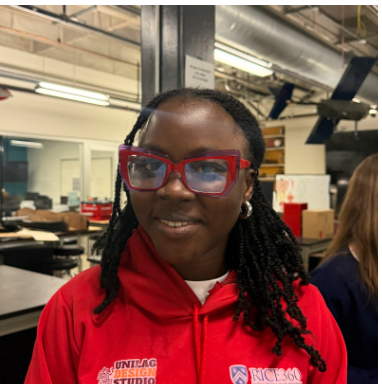
Eniola Adeleke is a recent graduate from the University of Lagos, Nigeria, and co-founder of Riascope, an AI-driven malaria detection system used to determine the presence of genus Plasmodium in blood-smeared samples. Malaria claims hundreds of thousands of lives annually, mostly in Africa. Through bold innovation and unified effort, Eniola and her team are working to fight the disease, saving thousands of children’s lives and paving the way for a malaria-free future. Riascope will be able to detect malaria parasites with an accuracy of over 90% focusing on accurate and early detection to help save precious lives. Eniola explains the innovative design behind Riascope and the impact it could make around the world.