
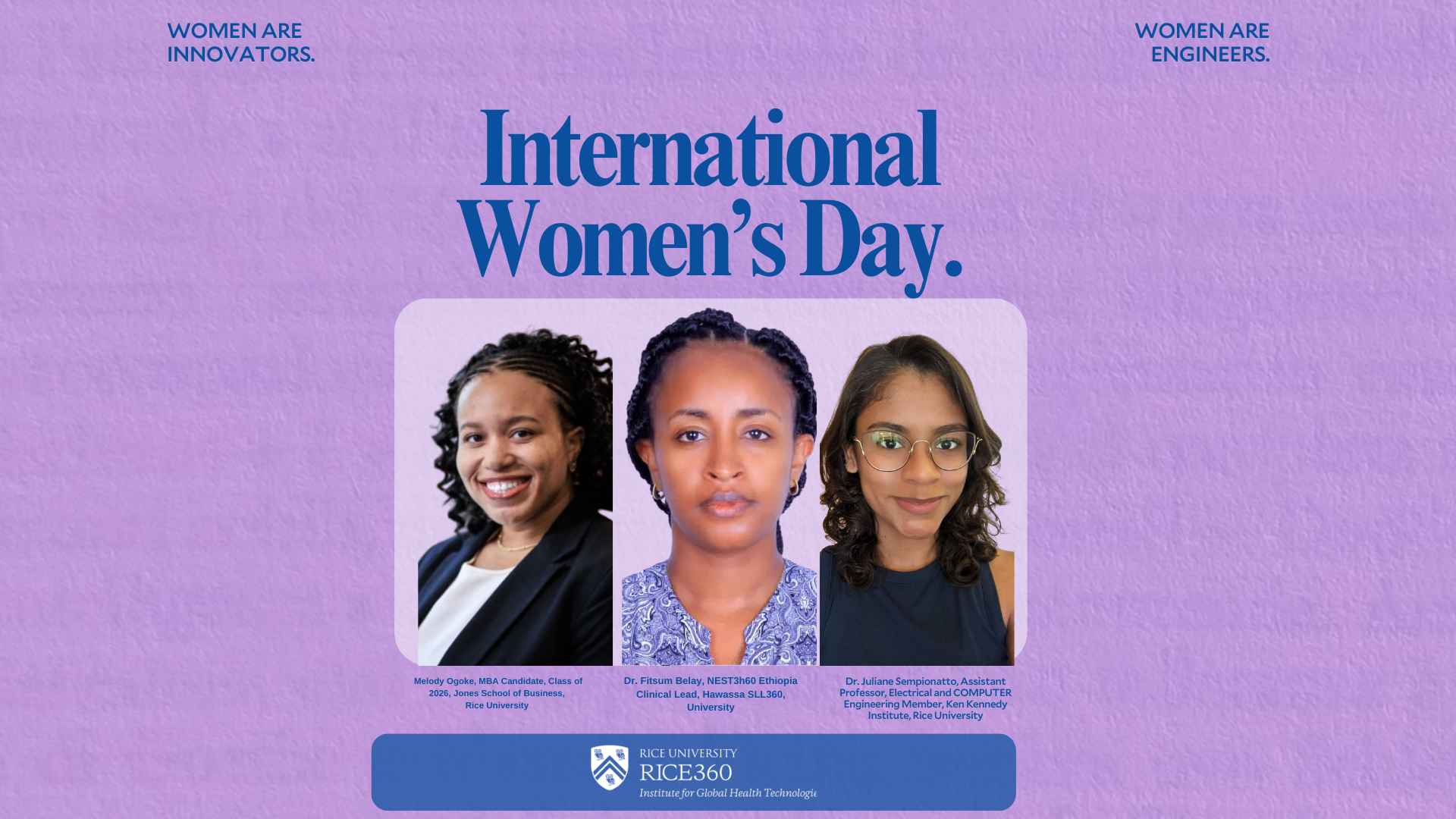
This International Women’s Day (IWD), Rice360 is privileged to work alongside women who are not only experts in their fields but are also dedicated advocates, "paying it forward" for the next generation of health leaders. Today, we are featuring three remarkable women who are leaders in their field: an innovator in wearable technology, a strategic leader in health operations, and a clinical expert in neonatal care. All were invited to discuss their journeys and values that drive their work toward a healthier, more equitable world.
__
Dr. Juliane Sempionatto, Ph.D.
Assistant Professor, Electrical and Computer Engineering Member of the Ken Kennedy Institute at Rice University
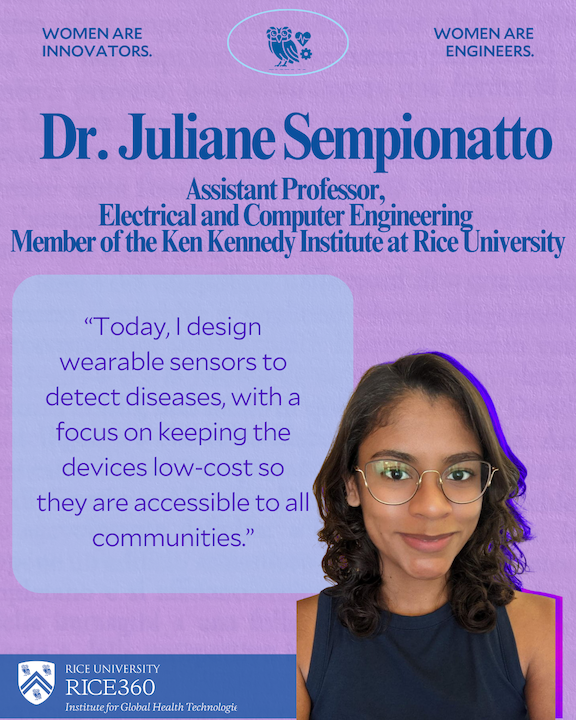
Dr. Juliane Sempionatto’s career journey transitioned from a curiosity about research to a high-level focus on biomedical innovation. She works with clinicians in Houston to develop affordable, wearable sensors designed to prevent chronic diseases, such as type 2 diabetes.
Interviewer: Can you explain what your career journey has looked like so far?
Dr. Sempionatto: It started with something I never imagined could be a career, studying and researching, which has now grown into a career where I work alongside clinicians here in Houston to design advanced, affordable medical wearables to detect treatable diseases. My initial motivation was to conduct research on the health issues that place the greatest burden on underserved communities and families. This led me to my early research activities to find a drug for neglected diseases, such as Dengue fever, diseases that affect low-income communities. From my work researching a cure for Dengue, I became more interested in disease detection. Today, I design wearable sensors to detect diseases, with a focus on keeping the devices low-cost so they are accessible to all communities.
Interviewer: Who is someone who inspires you and why?
Dr. Sempionatto : Teachers in general are a big inspiration in my life. I am also inspired by people who do outreach and advocate for those who are less privileged, individuals like Dr. Rebecca [Richards-Kortum]. I admire her so much. I want to be the person who believes in you and changes your life. As a professor, I hope I can be as inspiring as the teachers who inspired me. And I’m so happy I’m able to work towards health equity as part of my career, which I see as my way of advocating for others.
Interviewer: What is the most significant and rewarding part of your work?
Dr. Sempionatto : One of the most rewarding parts of my work is helping people the way I've been helped. I always say that I pay it forward, and having the resources to change people's lives is important to me. To use your talents for bigger things with greater impact, you must first know that you can influence change. It is my goal to help many young "Julianes" across Brazil realize their potential to accomplish bigger things and use their talents to make a difference. If I were able to help myself from where I am today, I think I would have grown so much faster, but I’m glad I can do that for others now.
__
Melody Ogoke
Professional MBA, Class of 2026 Rice University | Jones Graduate School of Business
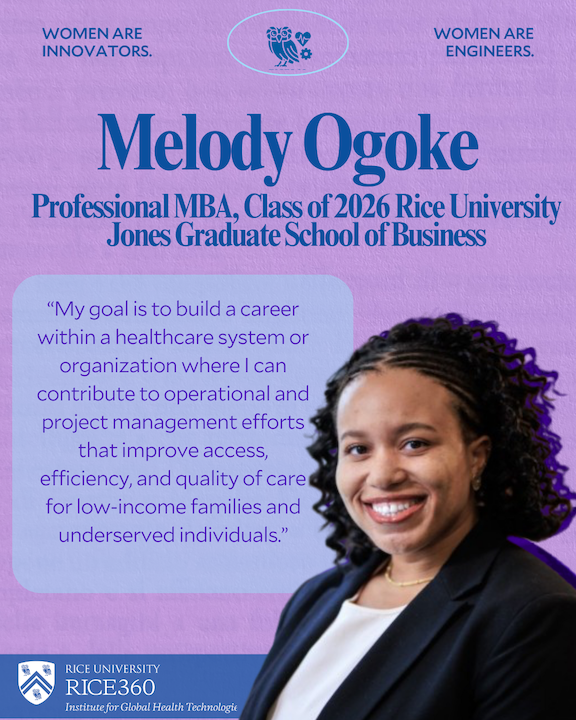
Melody Ogoke is committed to operational and project management in healthcare. She aims to bridge the gap between local community care and international health advancements to ensure that systems are well-equipped to serve patients.
Interviewer: Can you explain your education journey so far, what that has looked like, and what your future goals are?
Ms. Ogoke: My goal is to build a career within a healthcare system or organization where I can contribute to operational and project management efforts that improve access, efficiency, and quality of care for low-income families and underserved individuals. In the long term, I look forward to using my expertise to work on international healthcare projects that leverage healthcare systems to deliver better care for patients everywhere.
Interviewer: Are there any personal experiences or values/beliefs that would define you?
Ms. Ogoke: One of my earliest influential memories was watching my mom, who dedicated long hours to caring for patients as an ICU nurse. Her example made me realize I wanted to work alongside people committed to serving their community, even if it meant making sacrifices. My second experience was growing up as a Nigerian. By seeing the struggles and successes of members of my community, I learned how common diseases can cause long-term disabilities and developmental delays, and how quality healthcare could prevent these outcomes. This knowledge encouraged me to explore how healthcare was being delivered in African countries and how people were addressing the challenges to create a better future.
Interviewer: As a student preparing for this field, what kind of impact do you hope people like you will have on the future of health technology?
Ms. Ogoke: I’m excited to see how we’re moving closer to goals that improve access to care everywhere and create positive outcomes for all communities worldwide. When good health care is achieved it makes a difference in people's ability to access the care they need to grow and develop into who they’re meant to be. For anyone with an innovative spirit, I hope they stay patient and keep community needs at the forefront of their goals.
__
Dr. Fitsum Woldegabriel Belay, MD, Mphil
NEST360 Ethiopia Clinical Lead, SLL360, Associate Professor of Pediatrics and Child Health, Hawassa University
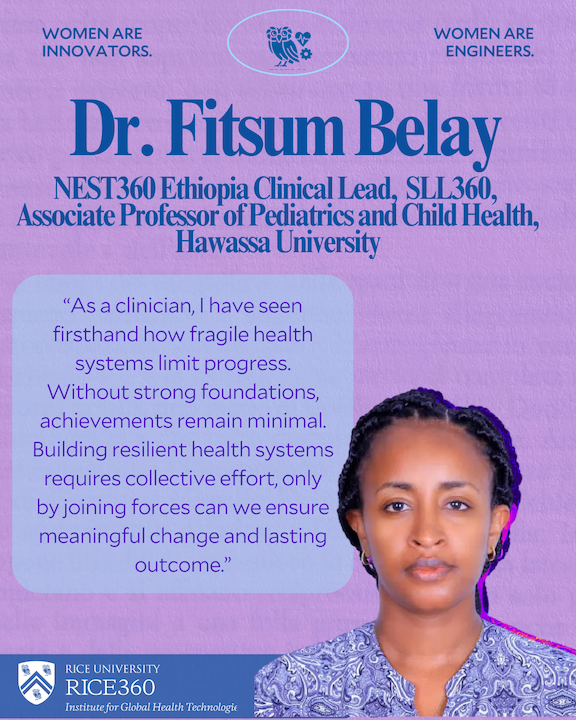
Dr. Fitsum Woldegabriel Belay is a clinician and executive leader whose career is rooted in a deep belief in equity. Her transition from clinical care to health systems leadership was sparked by a desire to strengthen the health systems that protect newborns and vulnerable children.
Interviewer: How has your career journey looked so far?
Dr. Belay: My passion to engage in maternal and child healthcare started when I was an elementary school student. One night, I was watching the news on TV, which described the high maternal and child mortality in Ethiopia. As a child, I was curious to know why that was happening. One reason that stayed with me forever was the shortage of healthcare professionals. That was the night I decided I should study medicine. Along the way, there was a critical moment where helping a single patient was not enough. That was a pivotal moment to engage in healthcare administration and executive roles to influence policy, health workforce development, and institutional culture for better care.
Interviewer: Who is someone who inspires you and why?
Dr. Belay: The people who inspire me and continue to inspire me are my parents. They see opportunities rather than limitations in things. That’s key to understanding the health system landscape in general. For me, identifying and focusing on opportunities rather than limitations is what keeps me moving.
Interviewer: How do you envision a future where everyone has access to quality healthcare?
Dr. Belay: I envision a future where quality healthcare is not dependent on geography, where you are or where you are coming from. It shouldn't depend on how much money you have. I envision a future in which healthcare is dignified, respectful, and evidence-based for everyone. This is the future we have to invest in and work toward collectively to ensure it is available to those who actually need it, and to our newborns and vulnerable kids out there.
__
Three women investing in the next generation
Dr. Juliane Sempionnatto, Melody Ogoke, and Dr. Fitsum Woldegabriel Belay remind us that progress in global health is not made solely in labs or offices—it's built by leaders like these three women who dedicate themselves to shaping healthcare to serve everyone. These women are each working toward a future in which their knowledge, resources, and impact drive change and inspire others to join them in making advancing better health care throughout the world.