
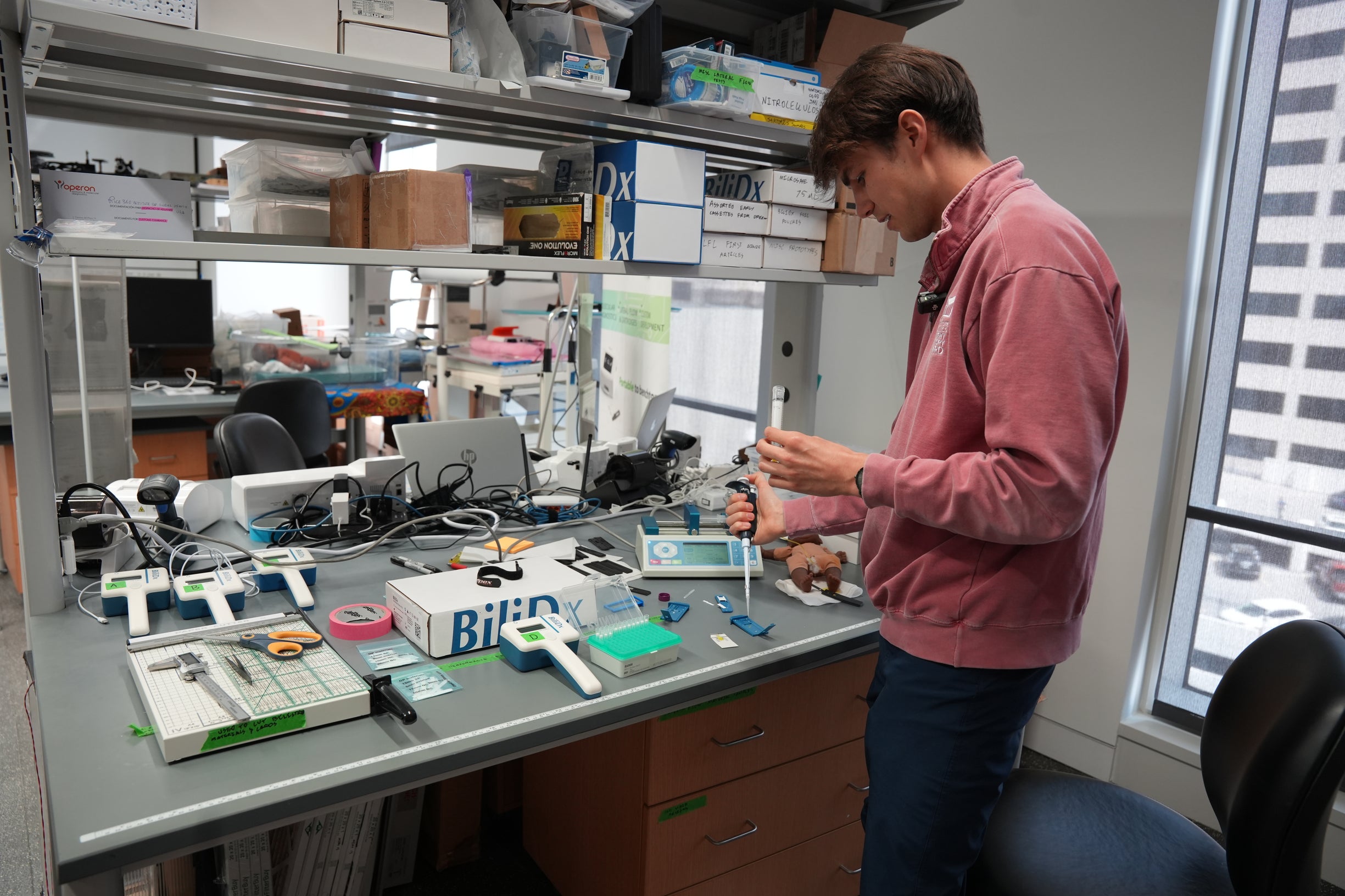
By Benjamin Shaw (pictured above in the Rice360 lab)
My name is Benjamin Shaw and I am working on the redesign of the BiliDx device as part of my fellowship for Rice360.
What were your previous experiences prior to joining Rice360 as a Global Health Fellow?
Before starting my Rice360 Global Health Fellowship, I had lots of great opportunities during my time at the University of Kansas (KU), where I earned both a BS in chemical engineering and an MBA.
During my undergrad, I was able to get exposed to research, working with two different labs. First, with the Shiflett Lab working with refrigerant sustainability through Project EARTH, and second, with point-of-care diagnostics using microfluidics with the Soper Lab at the Center of BioModular Multi-Scale Systems for Precision Medicine. Outside of research, I was heavily involved in Engineers Without Borders (EWB), where I led our Eco-Latrine project in Bolivia twice. Lastly, I spent a summer in Seville, Spain, as an intern with iGluco Tech, a startup launching a non-invasive glucometer.
During my MBA, I served as a Business Analyst at KU Innovation Park, mainly helping researchers from KU bring technologies from the lab to market. What was super cool was that I got to continue working with both Dr. Shiflett and Dr. Soper, since they were both working to commercialize their research. Also, in my MBA, I served as a Graduate Teaching Assistant for Calculus.
Fellowship project: BiliDx
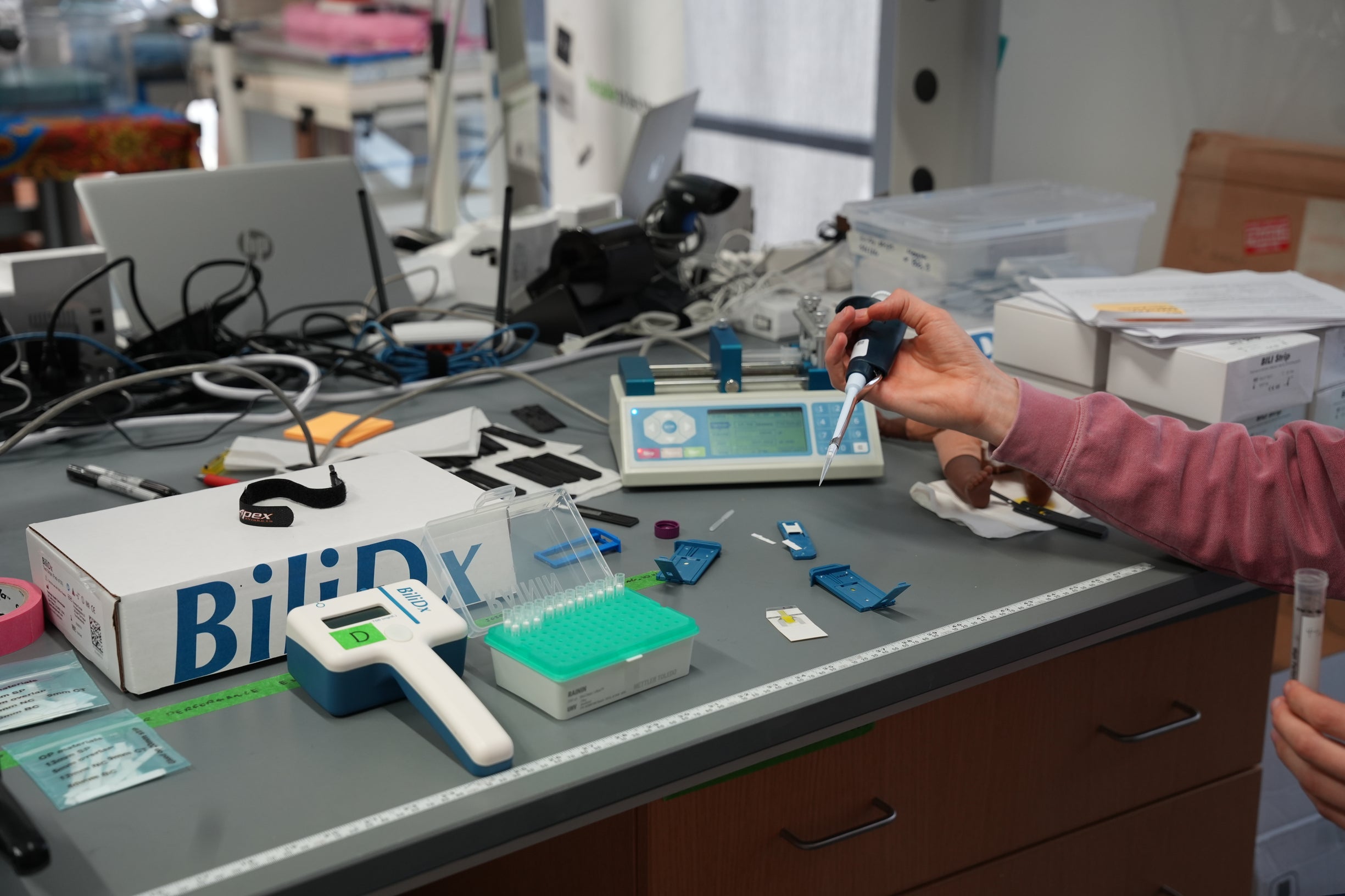
I am currently working on the BiliDx project. BiliDx is a point-of-care, low-cost device that measures serum bilirubin levels from a small drop of whole blood to aid in the diagnosis of jaundice in neonates. BiliDx is in use in hospitals across several African countries.
Currently, my primary focus during my fellowship is to advance a redesign of the BiliDx consumable portion of the device – the test strip, where blood is collected, and the plastic housing for the strip. The main goal was to reduce the cost of manufacturing the consumable, which would make the strip more affordable for customers. When evaluating redesigns to reduce costs, our team determined that we could also make improvements in other areas.
Project Development Milestones and Experiences
BiliDx can improve care and outcomes for newborns in resource-constrained hospital settings, underscoring the need to redesign the test strip to be more affordable and user-friendly. My Rice360 fellowship began as a project to move an existing design through performance testing, but it has since shifted to a broader redesign of the test strip assembly.
This fellowship has become a key experience in my career and a rewarding collaborative effort to significantly improve BiliDx by solving manufacturing and usability challenges. As an early-career engineer, working closely with senior researchers and technology developers while leading a design at this level is invaluable. Being so close to technology translation is very special for me, and I am grateful to be able to work on such an impactful project.
As a Rice360 Global Health Fellow, I have had the chance to work closely with 3rd Stone Design, our commercialization partner for BiliDx, on how to approach the test strip redesign and test prototypes. About every other week, I communicate with Robert Miros, the CEO of 3rd Stone, and the co-directors of Rice360, Rebecca Richards-Kortum and Maria Oden, to provide updates on the redesign project.
Learnings from BiliDX
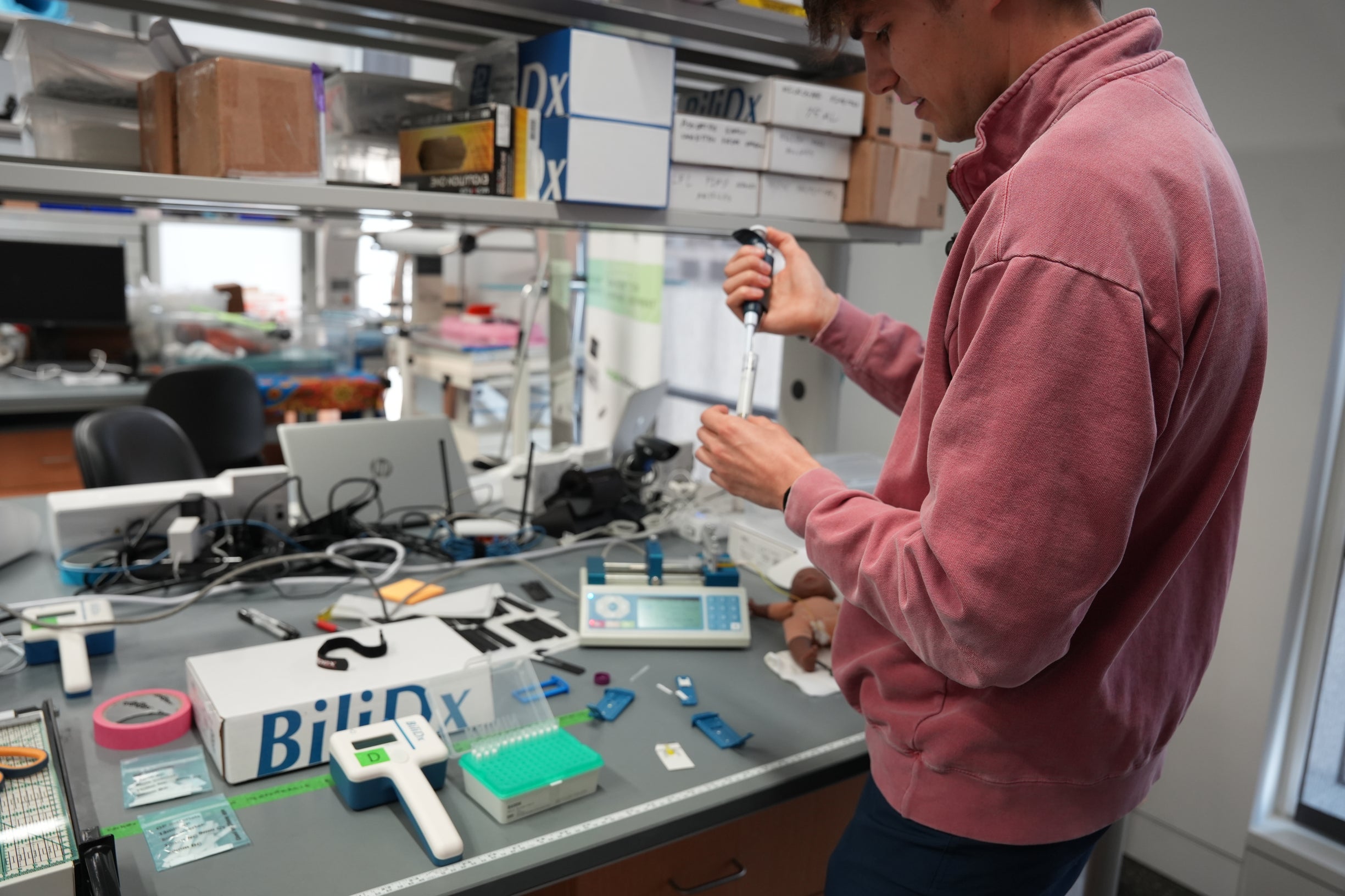
My predecessor on the BiliDx test strip redesign project, Joseph Peterson, made great progress. The design he left had four advantages, all responding to user feedback on a previous design, including: (1) reduced blood volume required to test, (2) removal of the need to use pipettes, (3) housing design matched the form factor for other high-volume tests, ideally reducing the cost, and (4) software improvements to reduce testing wait times.
Our team moved forward with testing this design alongside our colleagues in Malawi as part of a formal clinical study. The study included a summative usability study and benchtop validation tests.
However, testing revealed, as it often does, new insights and unanticipated challenges with usability and manufacturing. Test users struggled to collect enough blood for the test. And we learned that our manufacturing partner would be unable to automate the cassette's manufacturing/assembly using their equipment, negating the cost benefits of the updated cassette.
My work on the project shifted from validating the improved design to leading redesign efforts to address critical design elements identified through testing and manufacturing feedback. We began by reducing the number of housing components in the cassette and redesigned the card for manufacturing
With the BiliDx team and input from our technical partners, the latest iteration of the BiliDx test cassette has demonstrated improved performance in manufacturing and testing. We continue to refine the design to optimize these improvements.
Fellowship Opportunities – Growing New Skills
The skills I have honed during my fellowship include experimental design, data analysis, prototyping, and science communication, including presentations, data visualization, and storytelling. Growing these skills is especially important for my career aspirations as a principal investigator/professor. This fall, I am starting a bioengineering PhD program at the University of Maryland, College Park, and I believe this fellowship experience has laid the best possible foundation for success in a PhD program.
Through my fellowship, I have learned so much about proper experiment design, communicating experimental results clearly, drawing evidence-based conclusions, and choosing effective next steps to advance towards broader goals. I’ve noticed that it’s easy to get distracted by other questions when conducting experiments. There always seems to be more questions to answer and not nearly enough time to test everything we want, so being disciplined about addressing the most fruitful and important next steps is crucial. This fellowship has helped me gain wisdom about which questions are most important and, therefore, which next steps to prioritize.
Furthermore, the lab I am joining (Dr. Jenna Mueller’s global medical devices laboratory) has a history of working with Rice360 and 3rd Stone Design.
I am hoping to emulate the translational/implementation mindset from the BiliDx project into my future work during my PhD and throughout my career- turning research into real-world, life-saving impact. Overall, the fellowship fits into my career path extremely well, and I am very happy I chose to pursue it.
Interested in becoming a Rice360 Global Health Fellow? Apply today!