
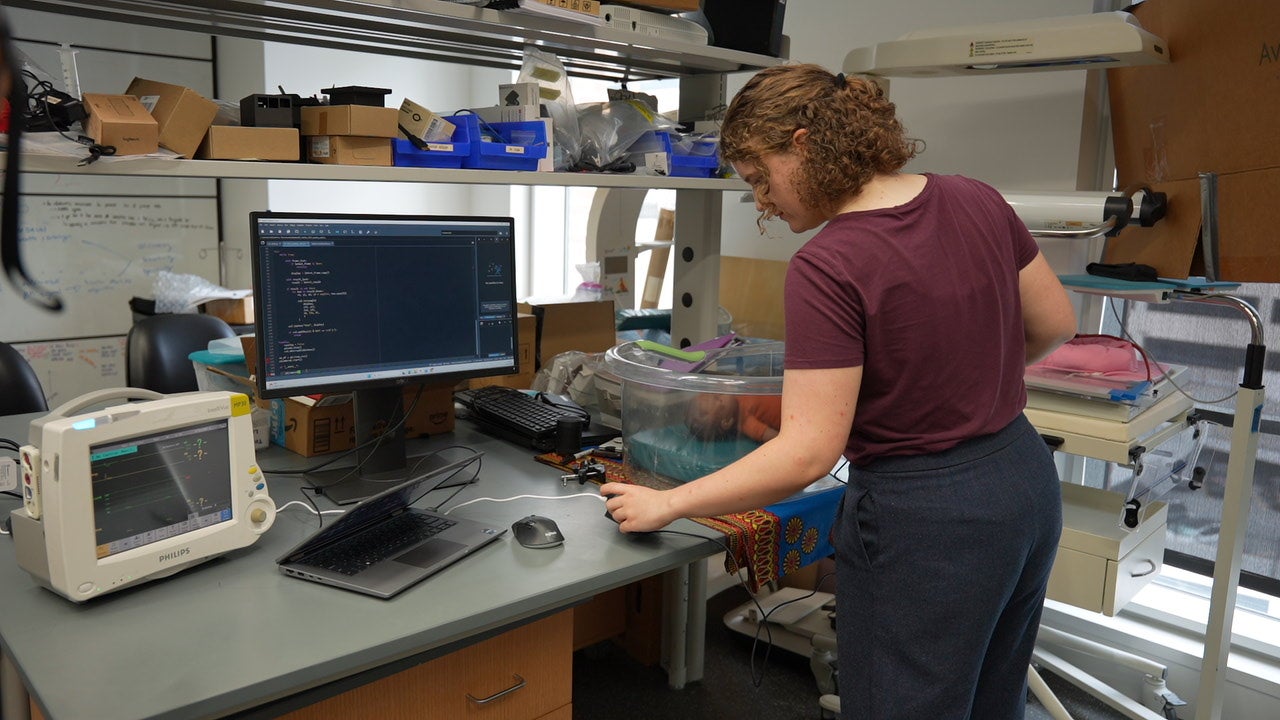
By Claire Wolfer-Jenkins (pictured above in the Rice360 lab)
After graduating from Purdue University with a Bachelor of Science, Claire was accepted into the Rice360 Global Health Fellowship, where she has been advancing the development of a low-cost, continuous respiratory rate monitor (RRM) that requires minimal interaction from busy nurses. Below, Claire shares insights from her work and exciting project milestones.
What were your previous experiences prior to joining Rice360 as a Global Health Fellow?
I graduated from Purdue University in May 2025 with a Bachelor of Science in neurobiology & physiology and minors in management and chemistry. I also had the opportunity to complete a data science certificate program at Purdue, which provided me with foundational coding skills I use daily.
At Purdue, I had the opportunity to lead research projects in two labs in the fields of developmental neuroscience and systems biology. In the Dooley lab, I completed a Biology Honors Thesis on twitch patterning in infant rats during REM sleep, aiming to contribute to our understanding of behavioral markers in typical sensorimotor development. In the Baloni lab, I worked on developing a de novo metabolic reconstruction of the model organism X. laevis for a study examining the potential neurotoxic effects of per- and polyfluoroalkyl substances (PFAS), which are common environmental contaminants.
As an undergrad, I also completed an internship with the National Institute on Drug Abuse (NIDA). During the internship, I worked in Dr. Justin Berk’s lab at Brown University, contributing to a variety of projects focused on hepatitis C virus (HCV) and medication for opioid use disorder (MOUD) treatment in carceral settings.
In the fall, I will begin my graduate studies in the United Kingdom as a Marshall Scholar. In my first year, I will study public policy at the University of Cambridge. I look forward to learning how policy initiatives can improve access to innovative health technology in underserved communities.
Fellowship Project: Respiratory Rate Monitor
Neonatal intensive care units (NICUs) in low-resource settings often lack enough continuous patient monitors for every baby admitted to the unit. The cost of monitoring equipment contributes to this limitation. This means that critical changes in vital signs, such as respiratory rate, can go unmonitored in neonatal units where nursing shortages are common. Due to a lack of continuous monitoring capabilities, clinicians in these settings may not be made aware when an infant has a very fast or very slow respiratory rate, which can be dangerous. Many premature babies in NICUs experience breathing pauses, for instance, which can be fatal if not detected and treated quickly. The respiratory rate monitor (RRM) aims to address this issue by providing a simple-to-use, low-cost, continuous respiratory rate monitor that hospitals are more likely to be able to afford and that requires minimal interaction from busy nurses.
Project Milestones: Refining Algorithms
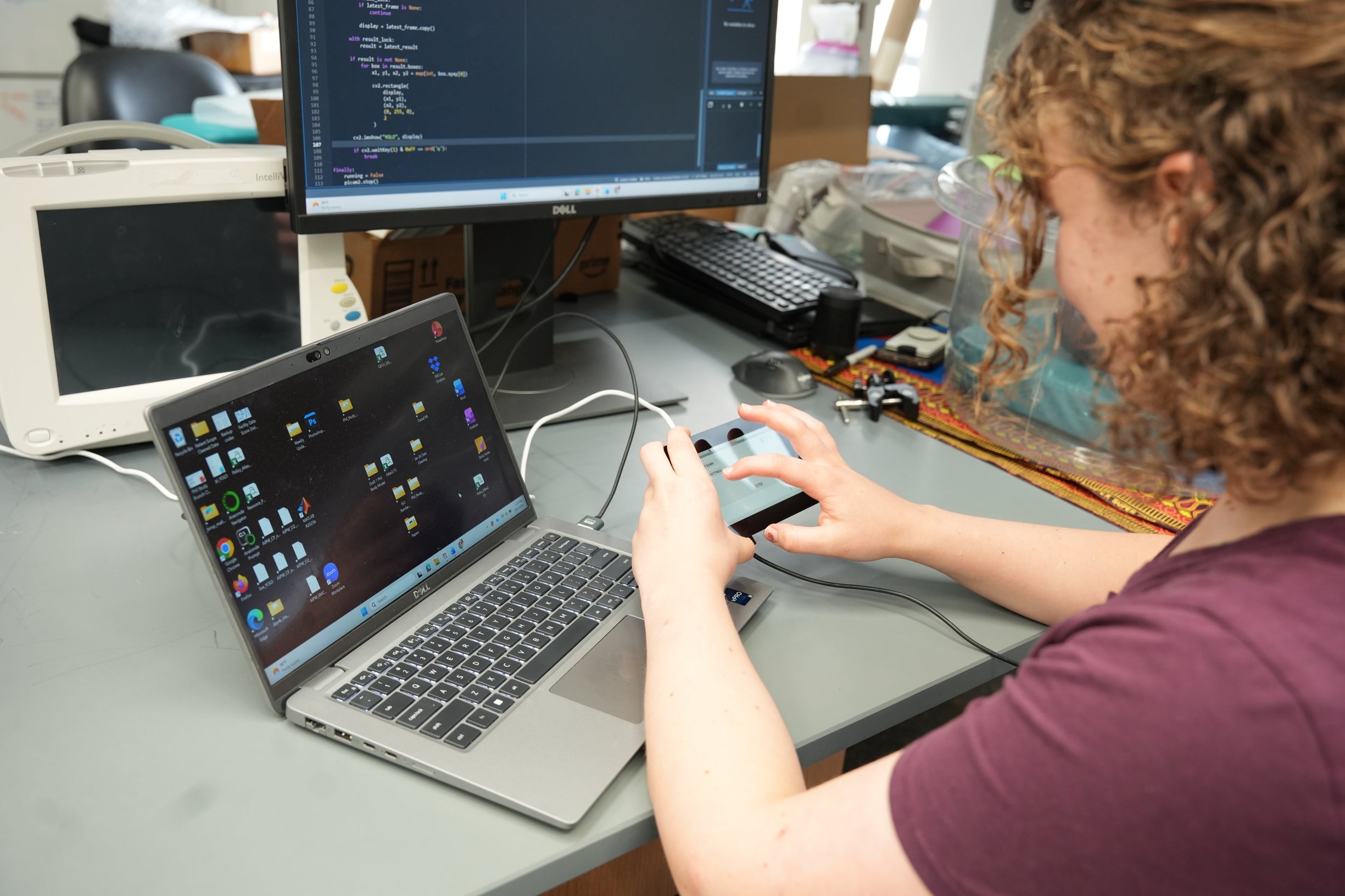
The current RRM prototype offers a completely contactless option for monitoring a newborn's breathing. This type of patient monitoring is uncommon, so it has been especially rewarding to focus on an emerging category of medical technology. A major consideration for this product is ensuring the algorithm can adequately analyze data from many hospital settings. Much of my work has focused on refining the RRM algorithm, developed by Rice360 engineer Noelle Nelson, which involves applying machine learning to track regions of interest that vary in quality, contrast, and background.
The contactless design of the device has the potential to also improve clinical care. Babies being monitored by this system are not attached to a device by cords, which can make it easier for mothers to quickly remove their babies from their cribs and provide Kangaroo Mother Care (KMC), a key intervention shown to improve outcomes for premature babies.
Learnings from Malawi
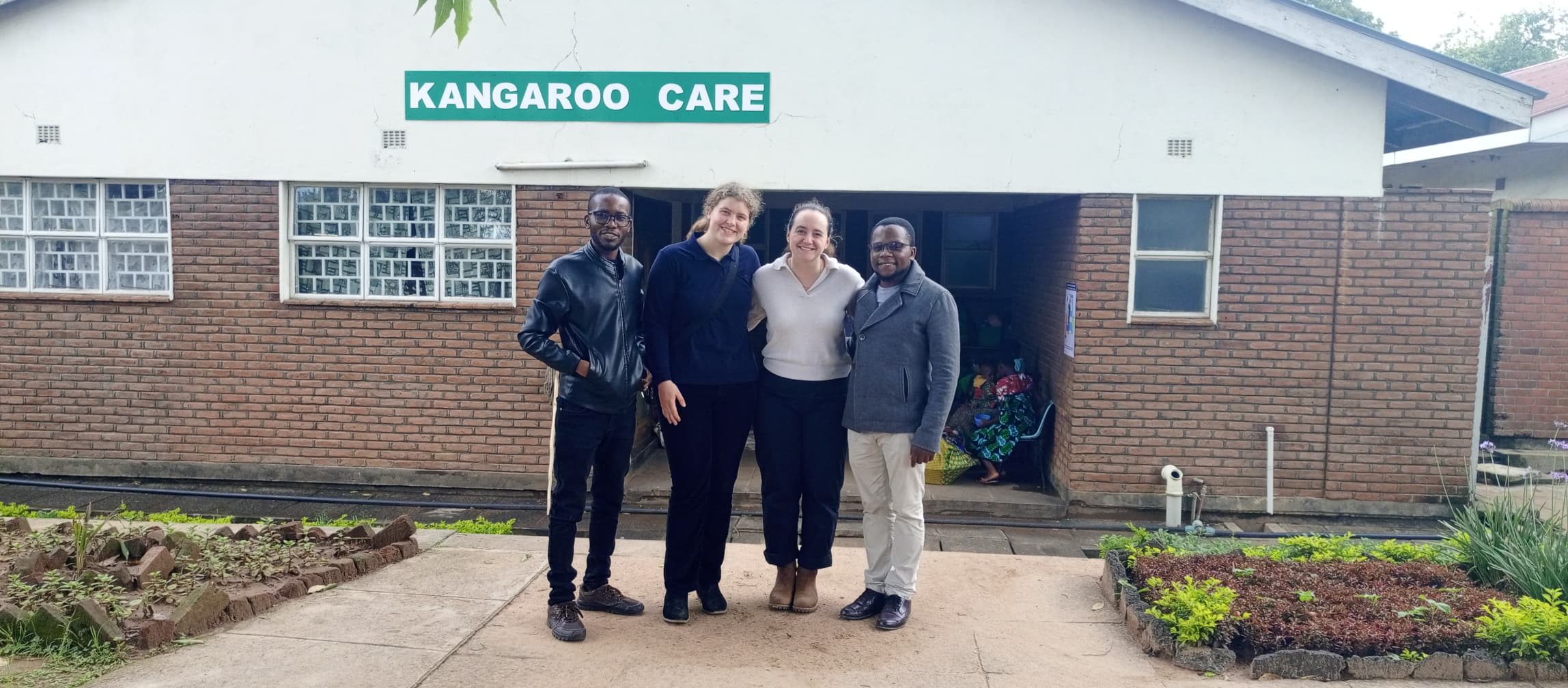
Traveling to Malawi was incredibly helpful in advancing this project. Firstly, it allowed our team to obtain essential clinical data to both validate that our current algorithm works across different hospital settings and to provide training data for the machine-learning region-of-interest tracking model.
While in Malawi, we conducted a usability study with clinicians. We brought a basic device prototype with us, had clinicians perform a series of tasks simulating use of the device in a clinical setting, and asked a set of follow-up questions about current respiratory rate monitoring practices and possible device features. The feedback was positive, with clinicians liking how simple the device is and emphasizing how useful it would be as a low-cost option for respiratory rate monitoring. We gained better insight into approaches to the device's design features, such as improvements to the user interface and alarm preferences, which support ease of use. Talking directly with clinicians about features was very helpful, as we were unsure how to approach certain features without understanding the typical clinical workflow.
Observing a NICU in Malawi firsthand helped me better understand the care setting we are designing for. I observed the impact of critical issues, including limited staffing and a lack of available beds. Additionally, it was incredibly impactful to witness the essential role that NEST360 technologies play in the NICU. NEST360 technologies were widely used throughout the ward to deliver life-saving care.
Global Health Fellowship Experience
Being a Rice360 global health fellow has given me the unique opportunity to work on technically challenging projects with the potential to make a tangible difference for patients around the world. It is very clear to me how every Rice360 technology in development can improve quality of care and ultimately patient outcomes. Working on these types of high-impact projects has been rewarding.
Additionally, one of the coolest aspects of the fellowship program is the opportunity to be immersed in the product development process. I remember my first tour of the office and being in awe as I was introduced to the many past and ongoing Rice360 technology development projects. I learned how Rice360 has translated projects all the way to market thanks to the work of passionate undergraduate students and post-baccalaureate fellows. Each product iteration I saw reflected hard work, problem-solving, and ingenuity.
Another aspect of the Rice360 Global Fellowship program that I have appreciated is having a community of fellow early-career engineers. It has been great to learn from the other fellows as we all work on different projects that leverage our unique skill sets.
Global Health Fellowship Opportunities
During my fellowship with Rice360, I have developed skills in resource-constrained design. Prior to this fellowship, much of my research did not directly apply to product design, and I did not have to consider how to make a solution that was both effective and low-cost. In the RRM, for instance, I have had to address the challenge of reducing the computational load of running a machine learning model in real time, so that the product can run on a low-cost computer. It has been a welcome challenge, prompting me to think more creatively about design solutions.
Additionally, through the fellowship, I expanded my technical skill set by exploring new forms of machine learning. I have also improved my interpersonal skills through close collaboration with an interdisciplinary and international team. I learn so much from my colleagues here in Houston and across Africa about engineering and the complexities of global health initiatives. I have appreciated the opportunity to contribute my expertise to the large-scale NEST360 initiative in collaboration with the 23 different organizations that make up the NEST360 alliance.
Interested in becoming a Rice360 Global Health Fellow? Apply today!