
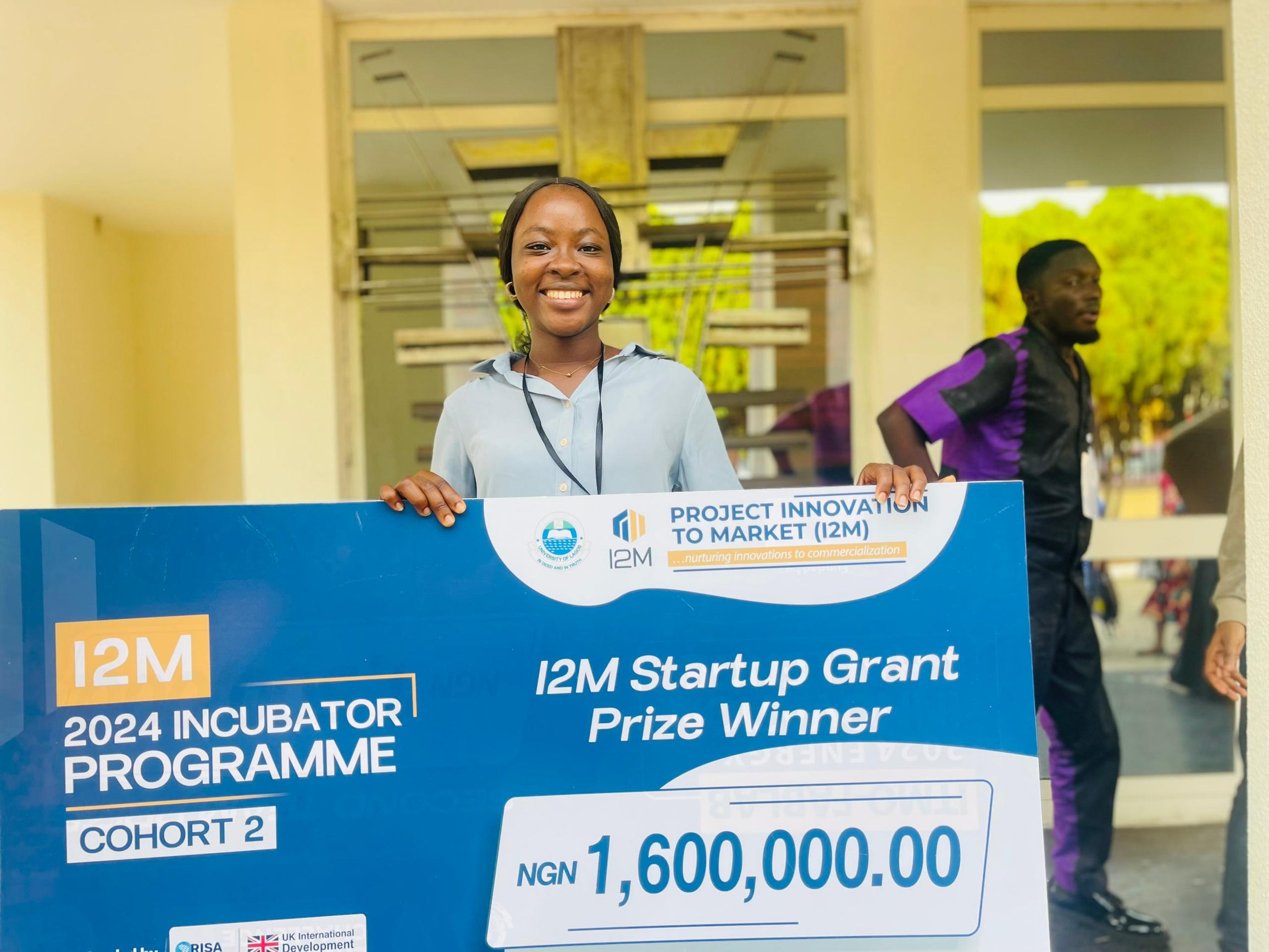
Rice360 Institute for Global Health Technologies caught up with program alums to discuss their experiences beyond the hedges. Eniola Adeleke '25 shares insights from her time as a Rice360 summer SEED intern and how her hands-on experiences in the Rice360 program have shaped her since graduating from the University of Lagos in Nigeria.
Can you briefly introduce yourself and your academic background? What extracurriculars do you participate in?
My name is Eniola Adeleke, and I am a final-year student studying applied physics and electronics at the University of Lagos, Nigeria (UNILAG). I grew up in Mushin, a densely populated area in Lagos, Nigeria. My interest has always been in biomedical engineering. I have also studied physics and electronics.
I enjoy working on biomedical engineering projects as much as possible —it's my passion. I like to position myself in places where biomedical engineering is happening, which is how I found myself at the UNILAG Design Studio, a biomedical engineering lab established in partnership with the Rice360 Institute for Global Health Technologies. I’m also a mentor in the Technovation Girls program, where I work with young girls to develop their tech skills and entrepreneurial mindset.
One of my first projects at the Studio was a heartbeat monitoring system, a time-tested method for monitoring the number of heartbeats per minute by detecting changes in blood flow or electrical activity associated with each heartbeat. I was thrilled to get it up and running, and I realized this was exactly what I wanted to do: create devices and tools that impact and save lives, especially within the healthcare system.
Since that first project, I have built numerous others. One of my most recent achievements is my startup, Riascope, which focuses on detecting malaria.
Malaria is prevalent in Nigeria. As a STEM Educator and a member of the student staff at the Unilag Design Studio, I founded Riascope to help people get diagnosed and receive care in a timely manner. Riascope is an AI-driven malaria detection system used to determine the presence of genus Plasmodium in blood-smeared samples. The system examines and screens samples using AI, and flags them if the sample image contains Plasmodium falciparum, a species of malaria common in Nigeria within four minutes. Our goal is to manufacture it locally using a local manufacturer in Nigeria and distribute the device throughout the Nigerian healthcare system, potentially reaching rural clinics that currently lack trained microscopists.
This past summer, Chevron sponsored me to participate in the Rice University Summer Experience in Engineering Design (SEED) internship where I spent time developing solutions to answer engineering challenges. Beyond the work itself, one of the most beautiful parts of the experience was simply living in Houston. I genuinely enjoyed every moment — the city felt warm, welcoming, and full of life. I made amazing friends like Allen, Maria, Helena, and Rahma, and we’ve stayed close. My roommate, Rahma, was incredibly lovely and made settling in so much easier.
I used my free time to really explore Houston thoroughly. I visited The Galleria, tried Dave’s Food Place in Rice Village, and discovered so many beautiful places around the city. I spent time at the Johnson Space Center (NASA), the Museum of Natural Science, the Houston Zoo, and the Museum of Contemporary Art. One of the most unforgettable moments for me was watching the Juneteenth fireworks from the hill at the Houston Zoo. The atmosphere was magical, and the lights filled the sky. I also loved sightseeing at Hippie Hill and watching the tram move quietly along Hermann Memorial Park in the evenings.
Another experience I cherished was cooking in Rice University's residential college's huge shared kitchen. The international students prepared their favorite delicacies from home. They shared them with the American students, and I loved being part of that cultural exchange — tasting dishes, sharing stories, and creating memories.
All these little adventures, moments of reflection, and the friendships I built made the internship far more than professional development. It became a deeply personal and joyful season of my life, one that made Houston feel like a second home. I still look forward to visiting Houston later for my graduate studies

How did you get involved with the UNILAG design studio, and what led you to UNILAG's Women in STEM program?
Women in STEM began as an initiative, with support from Chevron, that focuses on teaching young girls about invention education and, the engineering design process, and encourages them to stay in STEM. What led me to teach with the program was the sense of responsibility. During my time as a student staff member in the UNILAG Design Studio, we taught students about various aspects of studio work which primarily revolved around Invention Education. Sharing my knowledge gave me purpose, and this program allowed me to be a role model for girls interested in STEM. As we know, there is an underrepresentation of women in STEM globally, which makes female representation even more important. As a design studio staff member, I learned electronics, embedded systems, and mechanical fabrication – skills I want to teach other women.
We have two great initiatives in Lagos for female students: FemTech and Ladies in Tech. When working with these girls we tell them to look inward. We ask them to start thinking of problems to solve through the engineering design process they are learning.
We ask them to practice this in places they are familiar with, like their school and immediate environment. One group told us their school had a challenge with alerting students when it was time to change classes. The current system requires a student to manually ring a bell, causing them to miss class.
The FemTech students were then encouraged to build a solution, which they successfully completed building an automatic time-keeping system. It was interesting and inspiring to watch these students’ minds work. It intrigued me and made me think, “Wow, you mean in just six weeks of Invention Education training and engagement, and you came up with this idea?” It's really amazing.
What is a student project you have helped mentor from the Women in STEM programs that stands out to you?
I'm most impressed by this year's project, where we encouraged each team to launch startups with design innovation. Instead of just making them feel like, "Now you know this, you can apply it," we dug deeper. We taught them how to apply their skills by creating small-scale businesses. These girls came up with beautiful, brilliant ideas, such as laser-cutting wooden mirrors, desk organizers, and wooden clocks to decorate the office area in the studio. These projects may seem small, but they engage students in the engineering design process, enabling them to create a product they can sell. Imagine selling these clocks to offices, using items that you've created yourself with locally sourced materials.
Another project that really impressed me was a team that created a wooden hanger with the idea of selling it to people in the textile and fashion industries. The hanger has been customized using wooden materials that were laser-cut and then imprinted with designs and other elements.

How would you say that your Rice University SEED internship experience shaped you personally and professionally?
I was thrilled to be selected for the Rice University Summer Experience in Engineering Design (SEED) internship. This opportunity was sponsored by Chevron and in partnership with Rice360. I joined four other students from Africa to travel to Houston for a 7-week summer engineering design internship to develop innovative solutions to real-world, community and client-based challenges.
Personally, the SEED internship took me out of my comfort zone a lot, especially when working on my two projects. One of them I was familiar with, as it centered around electronics and embedded systems. It was something I was comfortable with, so I was able to understand and contribute to the group.
The other project placed me on the mechanical system side, which presented a significant challenge. Personally, I grew through that experience because it was unlike anything I was used to. I was able to explore mechanical engineering. Professor Bizesti and Dr. Holmes taught me about different mechanical tools while I applied my knowledge to understand why I was using each specific tool.
Professionally, I was shaped by the collaborative spirit I experienced during the SEED internship. I’ve often heard about the need to collaborate and the importance of teamwork, but in Houston, the team wasn't just a group of people working together,it was a team that was truly bonded. Everybody focused on the same goal of building something our clients would actually use. We worked at the Oshman Engineering Design Kitchen (OEDK) with the mindset of: Does the user like this product?
We were very keen on a user-centered design solution. Working with a client in mind was an important part of the process. I learned to think about the user before designing and throughout the design process. That user-centeredness really helped, and everyone was working towards that goal. That collaborative spirit and user-focused design were the key takeaways from my experience in the SEED internship.
What projects did your team work on during your SEED internship?
We worked on two major projects. Lights, Camera, Harvest for a company called Big S and Eggcellent Imposters for the Houston Zoo.
Big S is a company that addresses the problem of food insecurity worldwide through its vertical hydroponic farming system, which grows microgreens. Big S wanted us to design a vertical inspection camera to help monitor the growth of their plants because the manual process of monitoring microgreens was quite tedious. They wanted us to create a vertical system that is approximately 70 inches tall, with a camera whose components are completely food safe.
One variable we had to account for was the ten different tray levels in the growing room. The device we designed had to move up and down to monitor each level in real-time.
We also had to develop a web app that our users can use in conjunction with the vertical system. My clients currently have a software integration with their products called the TrueMaster software. They wanted us to integrate our software with theirs so it could be merged with their existing system, which was a significant challenge in itself. In seven weeks, we were able to build a 70-inch-tall camera system that would move up and down and pan around the plants to view and monitor the microgreens and their growth.
Our clients were very impressed. They could view all data in real time without having to manually check the plants. The exciting thing about the product is that our clients have informed us they will be installing it in various grocery stores, such as HEB. They are now considering installing at least one of our vertical integration cameras in each of their HEB stores in Houston.
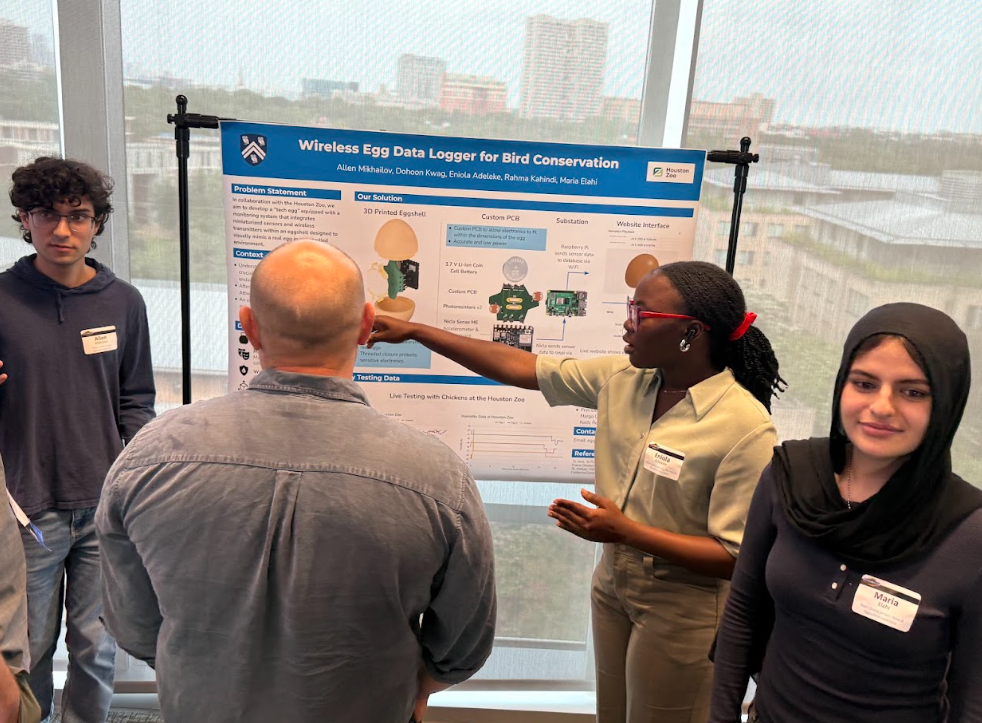
Another project was the Eggcellent Imposters for the Houston Zoo. The Zoo has a long history of protecting endangered species and advocating for animal rights. To protect these endangered species, it is essential to monitor vital aspects, such as incubation patterns for eggs. The goal is to monitor incubation patterns and track key parameters, such as temperature and humidity. These factors also help them create an artificial incubation system that they can use to incubate the eggs they produce.
We worked on creating a tech egg for a particular bird species, the Attwater’s Prairie Chicken. The Attwater’s Prairie chicken population was devastated after Hurricane Harvey, creating a need for scientists to monitor the species’ incubation patterns to help develop an artificial incubation system that supports species growth. They needed us to collect data on parameters such as the ambient temperature and the rotation of the egg.
They also wanted us to design an artificial egg. We created an egg with embedded miniaturized sensors inside. We conducted live testing with these eggs at the Houston Zoo. We kept them underneath a live chicken, where the chicken would sit on them, and we were able to measure parameters such as humidity, temperature, orientation, and light levels. We began by modifying the electronics that the previous team had developed, as their electronics didn’t fit the size of the egg we were trying to create. We then developed a core sensor that captures all the necessary parameters, eliminating the need for separate sensors for temperature and humidity. We had only one sensor that provided all the key parameters we needed. Then we created a printed circuit board from it and placed it inside the 3D printed poly-polished egg. We also had a substation that receives data through Bluetooth, providing a live representation of what is happening under the egg and the chicken in a website format.
That's what our team came up with. We did a lot of work. I worked in the electronics department and spent time in the substation, ensuring that we delivered high-quality products that were properly packaged for our clients.
What advice would you like to share with young women wanting to pursue a career in STEM?
I would say it’s okay to start being afraid. Start scared. When you start, you're afraid of failures but this is actually the right time to start because that's when growth begins. I was very scared of public speaking, but now I can speak to people and teach them. I don't get shy anymore; I overcame that fear.
Another important thing: take responsibility, whether it was given to you or not. Don’t wait for someone to assign you a task or tell you that you’re ready. If you see an opportunity to lead, to teach, to create something meaningful– take it. That’s how real growth happens.
You can do much more than you think. I never knew that the work I've been doing would lead me to the U.S. I would tell young women: Do it now. Don’t procrastinate. You can do great things, even from a small place. I came from a suburb of Lagos, but here I am, being the spokesperson for women around the world about success in STEM. Start Now. Don't be intimidated by failures.
Where do you see yourself in the future?
I aspire to pursue a PhD in biomedical engineering, focusing particularly on rehabilitation and medical device innovation for resource-limited communities. My long-term goal is to lead impactful projects that bridge engineering and healthcare, while mentoring young innovators in STEM to create sustainable solutions for global health challenges
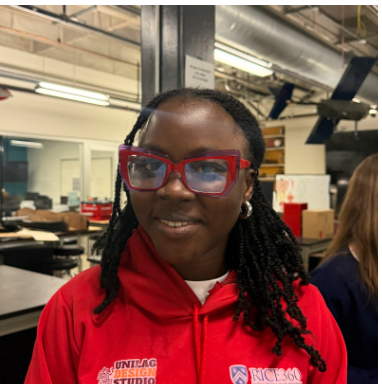
Eniola is a results-driven undergraduate of Applied Physics (Electronics) with strong research and analytical skills. Passionate about pursuing a career as an innovative researcher to make significant contributions in biomedical engineering, data science and Artificial Intelligence.